A no-fluff guide for career changers and new learners.
🕖Est. Reading Time: 10 minutes
If you’re trying to break into cybersecurity in 2026, you’re probably overwhelmed. And why wouldn’t you be?
There are dozens of cybersecurity certifications. Reddit says one thing. YouTube says another. LinkedIn influencers recommend advanced certs like they’re entry-level. And you’re left wondering:
Which cybersecurity certification should I actually start with?
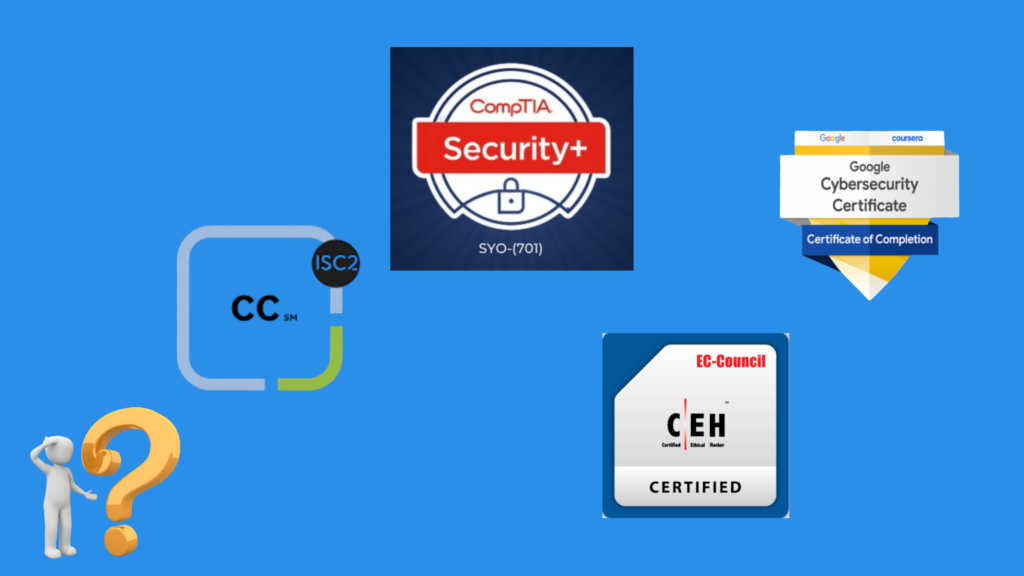
Here’s the honest answer: there isn’t one universal starting point. But for most serious beginners, especially career changers aiming for employment, CompTIA Security+ is the strongest first certification in 2026. That doesn’t mean it’s the only option, but it is the most strategically sound one for most people.
This guide will break it all down clearly so you can make an informed decision based on where you actually are right now.
Quick Answer: The Right Starting Point Depends on You
Before diving deep, here’s a fast decision framework:
- Completely new to IT and cybersecurity? Start with ISC2 Certified in Cybersecurity (CC).
- Serious about getting hired quickly? Start with CompTIA Security+.
- Need structure and guided learning first? Consider the Google Cybersecurity Professional Certificate — then move to Security+.
- Experienced in IT and want to pivot? Skip the foundation certs and go straight to Security+.
For most motivated beginners aiming for employment, Security+ offers the best return on your investment of time and money. Let’s explain why and when it might not be the right fit.
What Makes a Good Beginner Cybersecurity Certification?
Before choosing any certification, you need a set of criteria to evaluate it objectively. A good beginner certification should do three things:
1. Build Foundations, Not Specialization
Your first certification should teach you how cybersecurity actually works, rather than just focusing on one narrow slice of it. That means covering:
- Networking basics (TCP/IP, DNS, firewalls, VPNs)
- Core security principles (CIA triad, defense in depth)
- Risk management and governance
- Access control and authentication
- Threat types and attack vectors
- Incident response fundamentals
You don’t start with penetration testing or advanced cloud security. Specialization comes later. Think of it like medicine: you study general anatomy before choosing a specialty.
2. Be Recognized by Employers
This is where many beginners go wrong. A certification can be excellent for learning, but if employers don’t recognize it, it won’t move your resume past the initial screening filter.
That recognition matters enormously when your resume is competing against hundreds of others who also have “passionate about cybersecurity” in their summary.
✅Real Talk: Security+ appears in more entry-level cybersecurity job listings than any other certification. It’s HR-filter friendly, DoD-approved for certain roles (under Directive 8140), and seen as a baseline validation of security knowledge across industries.
3. Be Achievable Without Prior Job Experience
Your first certification should stretch you; it should not require years of experience you don’t have yet. Some certifications marketed to beginners (like CEH) are expensive and assume knowledge that takes years to accumulate. The right starting point builds your confidence and your resume simultaneously.
Side-by-Side Comparison: The Top 4 Options for Beginners
Here’s how the most commonly recommended beginner certifications stack up against the criteria above:
| Criteria | ISC2 CC | Security+ | Google Cert | CEH |
|---|---|---|---|---|
| Cost | Free / ~$50 | ~$392 | ~$49/mo | ~$1,000+ |
| Difficulty | Low | Medium | Low–Med | High |
| Employer Recognition | Growing | ★★★★★ | ★★★☆☆ | ★★★☆☆ |
| Job Listings Match | Low–Med | Very High | Low | Medium |
| DoD 8140 Approved | No | Yes | No | Yes (higher level) |
| Prereqs Required | None | None formal | None | Yes |
| Best For | True beginners | Job seekers | Structured learners | Experienced pros |
A Closer Look at Each Option
The table above gives you a quick snapshot, but numbers and star ratings only tell part of the story. Each certification has a different philosophy, audience, and career use case. Here’s what you actually need to know about each one before making your decision.
Option 1: ISC2 Certified in Cybersecurity (CC) — The Gentle On-Ramp
The ISC2 CC was purpose-built as a true entry-level certification. It requires no prior cybersecurity experience and has been offered free of charge for new registrants (check ISC2’s current pricing, as promotions vary).
What It Covers:
- Basic security principles
- Risk concepts and management
- Access control fundamentals
- Network security basics
- Security operations and incident response
Who It’s For
The CC is best suited for people who are completely new to IT — not just cybersecurity, but computing concepts in general. If terms like “subnet,” “firewall,” or “access control list” are unfamiliar to you, starting with the CC is a smart move. It provides a structured introduction without overwhelming you.
It’s also a lower-risk financial entry point. If you’re not yet sure whether cybersecurity is the right path for you, the CC lets you test the waters before committing hundreds of dollars to Security+.
Where It Falls Short
The CC does not yet appear frequently in job listings the way Security+ does. Many employers still default to requesting Security+ as their baseline certification requirement. This doesn’t make CC worthless, but it does mean most people will need to pursue Security+ after completing it.
If you start here, plan to move on. The CC is a stepping stone, not a destination.
Realistic Study Timeline
- Background: No IT experience
- Study time: 4 to 8 weeks at 5 to 10 hours/week
- Resources: ISC2’s free self-paced course, practice exams
Option 2: CompTIA Security+ — The Strategic Default
If your goal is employment, Security+ is the strongest first certification for most people. It has been the industry’s de facto entry-level security certification for over two decades, and that reputation is well-earned.
What It Covers
The current exam (SY0-701) covers six domains:
- General Security Concepts: Cryptography, authentication, security controls
- Threats, Vulnerabilities, and Mitigations: Attack types, indicators of compromise, threat intelligence
- Security Architecture: Network segmentation, cloud security, resilience strategies
- Security Operations: Identity management, monitoring, incident response
- Security Program Management: Governance, risk, compliance, data privacy
- Vulnerability Management: Scanning, analysis, and remediation frameworks
This breadth is exactly why employers trust it. It tells a hiring manager that you understand the full landscape of cybersecurity, not just one corner of it.
Why Security+ Is the Smart Default
Security+ appears in thousands of job listings for roles including:
- SOC Analyst (Tier 1 and 2)
- IT Security Analyst
- Network Security Administrator
- Systems Administrator with security responsibilities
- Junior Penetration Tester (in combination with other certs)
🏛️Government & Defense: CompTIA Security+ is DoD 8140 approved, meaning federal agencies and defense contractors often require it as a minimum for security roles. If you have any interest in working in the government, defense, or cleared contractor space, Security+ is non-negotiable.
The Reality Check: It’s Not Easy
Security+ is not a lightweight certification, but it is achievable without a degree or prior cybersecurity experience. Most beginners who pass dedicate around 1–2 hours per day over the course of their preparation. If you already work in IT, you may need less time. If you’re starting from scratch, lean toward the longer end.
- No IT background: Budget 3–4 months. Spend the first few weeks on networking and OS fundamentals before diving into Security+ material directly.
- Some IT experience: 6–10 weeks is realistic, mainly filling gaps in security terminology, risk management, and compliance concepts.
For resources, a combination of one strong video course, one book, and regular practice testing is enough for most candidates. The two video courses that consistently stand out are Professor Messer’s free Security+ course (covers all SY0-701 objectives at no cost) and Jason Dion’s course on Udemy (scenario-focused, frequently on sale for under $20).
For reading, the CompTIA Security+ Study Guide by Mike Chapple and David Seidl (Sybex) is the most widely recommended. Pair any of these with consistent practice testing, and aim to score above 80% on timed full-length exams before booking your exam date.
Option 3: Google Cybersecurity Professional Certificate — Structured Learning First
The Google Cybersecurity Professional Certificate (available on Coursera) is not a traditional certification exam. It’s a multi-course learning program designed to introduce you to cybersecurity concepts, tools, and workflows at a comfortable pace.
What It Covers
- Foundational security concepts and terminology
- Linux command line basics
- SQL for security analysis
- SIEM platforms (including hands-on with Chronicle and Splunk)
- Network traffic analysis
- Incident response workflows
- Python scripting introduction for automation
Where It Genuinely Helps
If you learn better with video lessons, guided labs, and a structured curriculum rather than self-directed exam prep, this program is excellent. It’s particularly useful for complete career changers who have never worked in tech before and want to build familiarity with tools before sitting for a formal exam.
The cost model (subscription-based at ~$49/month) also makes it accessible if you can’t afford to pay $392 for a Security+ voucher upfront.
Where It Falls Short
It is important to understand that the Google Cybersecurity Certificate is not a substitute for Security+ in job listings. Employers filter for certifications they recognize, and most ATS systems and HR teams are looking for Security+, not Google’s certificate.
Many learners complete the Google program and then still need to pursue Security+ to be competitive. Think of it as a very good prep course, not a final destination for job seekers.
Should Beginners Start with CEH (Certified Ethical Hacker)?
Ethical hacking and penetration testing get a lot of attention online. Offensive security roles are exciting, the work seems cool, and CEH is a well-known name. So it’s understandable why many beginners consider it.
But here’s the honest answer: No, CEH is not appropriate as a first certification.
Here’s why:
- It’s expensive: The exam and training can cost $1,000+ through EC-Council’s official channel
- It assumes prior knowledge: CEH expects familiarity with networking, operating systems, and basic security concepts
- It focuses on offense before defense: You can’t effectively attack systems you don’t understand how to defend
- Its reputation in practice: Many experienced security professionals consider CEH a “marketing cert” compared to hands-on alternatives like OSCP.
💡 The Rule: Master defense before offense. Ethical hacking is a specialization. Security+ first, then consider CEH or eJPT/OSCP once you have a job or 12+ months of experience.
👉 Think you have the foundational knowledge for CEH? Test your ethical hacking knowhow with our CEH practice tests now.
What Matters More Than Your First Certification
Here’s something many beginners don’t hear often enough:
Your first certification alone will not get you hired.
Certifications open doors. Skills keep them open. Every hiring manager knows that someone can pass an exam without knowing how to actually work in security. What makes your profile stand out is combining your certification with real, demonstrable skills.
Practical Skills That Accelerate Your Career
- Home Lab Practice: Set up virtual machines (VirtualBox or VMware) to practice configurations, log analysis, and basic forensics
- TryHackMe or Hack The Box: Interactive browser-based labs that teach real-world attack and defense techniques without specialized hardware
- Networking Fundamentals: Use Cisco Packet Tracer or GNS3 to understand how packets actually move through networks
- Log Analysis: Practice reading Windows Event Logs, syslog, and firewall logs — this is core SOC work
- GitHub Portfolio: Document your lab projects, write-ups, and learning notes. Hiring managers love seeing initiative
Free Resources Worth Bookmarking
- Professor Messer : Free Security+ video course and study materials
- TryHackMe : Structured learning paths from beginner to advanced
- SANS Cyber Aces : Free online tutorials for OS, networking, and security fundamentals
- Cybrary : Free foundational courses with paid upgrade options
- NIST Glossary : The authoritative source for cybersecurity terminology
Common Mistakes Beginners Make (and How to Avoid Them)
Collecting Certifications Without Hands-On Practice
Earning three certifications in quick succession without reinforcing them through labs and real cybersecurity tools creates a thin résumé. Interviewers will probe beyond what the exam covers. Applied skills are what get you through technical interviews.
Jumping Into Advanced Certifications Too Early
Seeing “OSCP” or “CISSP” mentioned online and deciding to skip the fundamentals is a common and costly mistake. Advanced certs assume real-world familiarity. Skipping the basics makes the material harder to absorb and significantly increases the risk of failure.
Ignoring IT Fundamentals
Cybersecurity is built on top of IT. If you’re weak on networking (how DNS works, what a VLAN is, how TLS functions), you will struggle with Security+. Before investing in a cert, spend time with networking basics. CompTIA Network+ or Professor Messer’s free networking content are good starting points.
Waiting Until You “Feel Ready” to Apply
There is no magic point of readiness. Apply for entry-level roles (junior SOC analyst, IT support, helpdesk) while you’re still studying. The interview experience alone will teach you things no certification can. Many people land their first security-adjacent role before finishing Security+.
Falling for “Bootcamp” Marketing
Many expensive bootcamps promise to make you job-ready in weeks. Most cannot. Be skeptical of any program claiming guaranteed job placement or dramatic salary jumps without verifiable evidence. Self-study combined with free/low-cost resources has produced thousands of successful security professionals.
Your Learning Roadmap: From Zero to Employed
Here’s a realistic timeline framework based on your starting point:
| Phase | Focus | Target Certification |
|---|---|---|
| Foundation (0–6 months) | Networking, OS basics, security concepts | ISC2 CC or CompTIA A+ |
| Entry-Level (6–12 months) | Threats, risk, architecture, compliance | CompTIA Security+ |
| Specialization (12–24 months) | Pen testing, cloud, SOC, SIEM | CEH, CySA+, AWS Security |
| Advanced (24+ months) | Architecture, management, leadership | CISSP, CISM |
Final Recommendation
Let’s remove all ambiguity.
Whichever path you choose, remember this: the certification gets your résumé past the initial filter. The skills, the labs, the curiosity, and the continuous learning are what build your career.
There may be no perfect starting point. But there is a strategic one — and for most people breaking into cybersecurity in 2026, that strategy begins with Security+.
👉 Ready for Security+? Start with our free practice tests and study guides to build your confidence and pass the exam.