🕣Estimated Reading Time: 8 minutes
Want to learn cybersecurity while commuting, cooking dinner, or winding down after work? A good podcast can turn idle hours into productive study time. The right cybersecurity podcast works in the background and keeps you connected to real-world threats, attack stories, and industry thinking without demanding that you sit at a desk.
Podcasts are one of the most underrated learning tools in cybersecurity. They won’t replace hands-on labs or certification study. But they do something those resources often can’t: they build intuition. You hear how professionals think through problems, how breaches actually unfold, and how the industry is evolving in real time. Over months of listening, that exposure compounds into something genuinely useful.
In this guide, you’ll find the best cybersecurity podcasts worth your time in 2026. The list covers everything from beginner-friendly storytelling shows to deeply technical deep dives for seasoned practitioners. Whether you’re just starting out or working toward your next certification, there’s something here for you.
Quick Comparison Table
| Podcast | Best For | Level | Format | Frequency |
|---|---|---|---|---|
| Darknet Diaries | Storytelling learners | Beginner to Intermediate | Narrative / Case studies | Biweekly |
| CyberWire Daily | Staying updated daily | Beginner to Intermediate | News briefing | Daily (weekdays) |
| Smashing Security | Beginners who want engaging content | Beginner | News + commentary | Weekly |
| Security Now | Deep technical understanding | Intermediate to Advanced | Technical deep dives | Weekly |
| Risky Business | Professionals and serious learners | Intermediate to Advanced | News + interviews | Weekly |
| Malicious Life | Learning through cyber history | Beginner to Intermediate | Storytelling | Biweekly |
| Hacking Humans | Social engineering awareness | Beginner | Practical / Awareness | Weekly |
| CISO Series Podcast | Career growth and leadership insights | Intermediate to Advanced | Panel / Discussion | Weekly |
Tap any podcast name to jump to its full review below.
Top Cybersecurity Podcasts in 2026
1. Darknet Diaries
Official site: darknetdiaries.com
Level: Beginner to Intermediate
Format: Narrative storytelling and case studies
Frequency: Biweekly
If you’re new to cybersecurity and you’ve been told to “just go read documentation,” Darknet Diaries is the antidote. Created and hosted by Jack Rhysider, the show tells the true stories behind some of the world’s most significant hacks, breaches, cybercrime operations, and digital espionage cases. Episodes are scripted, researched, and produced like a documentary, not a technical lecture.
What makes Darknet Diaries effective for learners is that it doesn’t just describe what happened. It walks you through the human decisions, miscalculations, and motivations on both sides. You come away with a real sense of how attackers think, how organizations fail, and how a single overlooked vulnerability can cascade into a catastrophic breach.
Past episodes have covered everything from the Bangladesh Bank heist to the life of an underground credit card fraudster to nation-state cyber operations. The stories are compelling on their own terms. For anyone studying for a certification or trying to build a mental model of the threat landscape, the contextual depth is genuinely valuable.
Why it belongs on your list: Darknet Diaries is one of the most accessible cybersecurity podcasts available today. No prior technical knowledge is required, and new listeners can start with any episode. It’s an especially strong complement if you’re working through foundational study material and want to see how real-world attacks connect to the concepts you’re learning. If you’re just getting started and exploring whether cybersecurity is the right path, take a look at our guide on how to get into cybersecurity alongside your listening.
2. CyberWire Daily
Official site: thecyberwire.com
Level: Beginner to Intermediate
Format: News briefing
Frequency: Daily (weekdays)
If you want to stay current on cybersecurity without doom-scrolling threat feeds, CyberWire Daily is the most efficient way to do it. The show delivers a tightly produced daily briefing covering the most important security stories, vulnerability disclosures, threat actor activity, and policy developments. Most episodes run between 20 and 30 minutes, which fits neatly into a morning commute or workout.
Host Dave Bittner combines crisp reporting with regular guest segments featuring researchers, vendors, and analysts who explain what the day’s headlines actually mean. The tone is professional but never dry. You get enough technical detail to understand the substance of a story without getting buried in jargon.
For learners, CyberWire Daily serves two important purposes. First, it familiarizes you with the names, terminology, and recurring themes that shape the industry, such as threat groups, CVE numbers, security vendors, regulatory frameworks, and emerging attack patterns. Second, it gives you talking points. If you’re preparing for interviews or trying to sound credible in professional conversations, listening regularly builds the kind of fluency that’s hard to fake.
Why it belongs on your list: CyberWire Daily is the closest thing the industry has to a daily newspaper. It’s not designed to teach you how to configure a firewall, but it will teach you how the cybersecurity world thinks and what it’s worried about right now. Pair it with our cybersecurity certification guide to connect the daily news cycle to the specific skills employers value.
3. Smashing Security
Official site: smashingsecurity.com
Level: Beginner
Format: News + commentary
Frequency: Weekly
Smashing Security is what happens when two veteran security professionals decide to make cybersecurity news genuinely entertaining. Hosts Graham Cluley and Carole Theriault have been covering infosec for decades, and the show leans on their experience to break down the week’s biggest stories with humor, sharp commentary, and the occasional rant.
Each episode typically covers two or three current incidents in depth, ranging from major breaches and scam campaigns to bizarre privacy violations and questionable corporate decisions. Guests join most weeks, adding additional perspective from across the industry. The format is conversational rather than scripted, which makes it feel more like sitting in on a smart chat with friends than listening to a formal briefing.
Where Smashing Security really shines is in how accessible it is. Cluley and Theriault explain technical concepts in plain language without dumbing them down. If a story involves a particular type of attack or vulnerability, they take the time to explain it clearly so newcomers can follow along. That makes the show one of the most welcoming entry points for people who are curious about cybersecurity but worried they won’t understand the technical content.
Why it belongs on your list: Smashing Security is the podcast you recommend to friends and family who keep asking what your cybersecurity job is about. For beginners, it’s a low-pressure way to build awareness of current threats, common scams, and the broader security conversation. Combined with structured study resources like our Security+ study guide, it adds context and color to the technical foundations you’re building.
4. Security Now
Official site: grc.com/securitynow.htm
Level: Intermediate to Advanced
Format: Technical deep dives
Frequency: Weekly
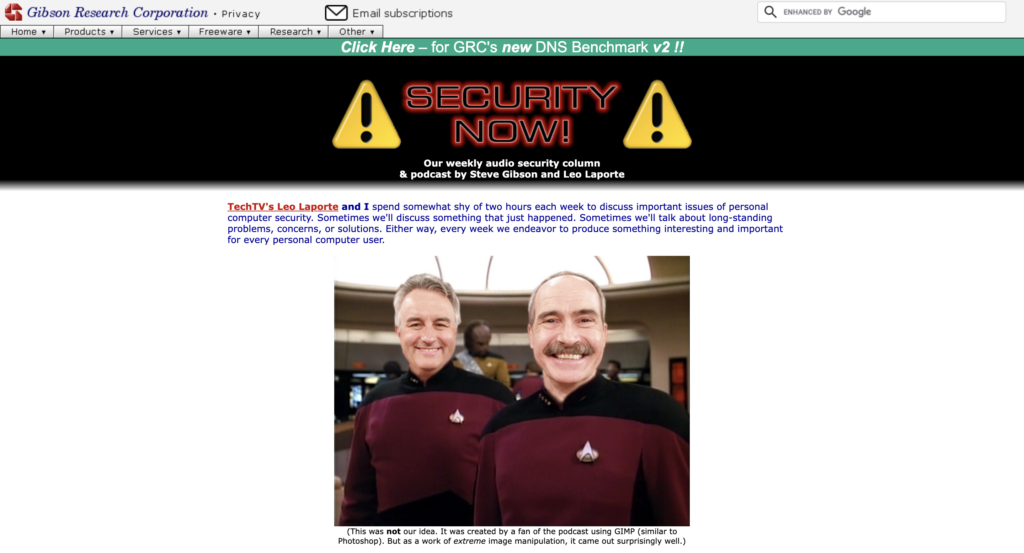
Security Now is one of the longest-running cybersecurity podcasts in existence, having launched in 2005 with hosts Steve Gibson and Leo Laporte. It’s also one of the most technically rigorous shows you’ll find anywhere in the medium. Episodes routinely run two hours or longer and cover topics with a depth that most other podcasts don’t even attempt.
Gibson is a software developer and security researcher with a particular gift for explaining how things actually work under the hood. When a major vulnerability is disclosed, Security Now will often dedicate significant time to walking through the underlying mechanism, not just describing the impact. That makes it an exceptional resource for learners who want to move beyond memorizing terminology and develop a real understanding of how cryptographic protocols, network attacks, and operating system internals actually function.
The show isn’t beginner-friendly in the traditional sense. Episodes assume you’re comfortable with networking concepts, basic cryptography, and security fundamentals. But if you’re at the stage where surface-level explanations have started to feel unsatisfying, Security Now is exactly what you need. Many listeners describe it as the show that finally made advanced concepts click after years of half-understanding them.
Why it belongs on your list: Security Now is essential listening for intermediate and advanced learners who want technical depth. It pairs particularly well with structured exam prep when you’re preparing for harder certifications.
5. Risky Business
Official site: risky.biz
Level: Intermediate to Advanced
Format: News + interviews
Frequency: Weekly
Risky Business is the cybersecurity podcast that working cybersecurity professionals actually listen to. Hosted by Australian journalist Patrick Gray, the show combines a weekly news roundup with substantive interviews featuring some of the most respected practitioners, researchers, and decision-makers in the industry.
The news segment is opinionated in the best possible way. Gray doesn’t just report what happened. He tells you what he thinks about it, why it matters, and what’s likely to come next. His takes are informed by years of relationships across the industry, and his guests reflect that network. Recent episodes have featured CISOs from major companies, government cyber officials, threat intelligence leaders, and prominent independent researchers.
For learners aiming at a serious cybersecurity career, Risky Business offers something you can’t easily get from courses or certifications: exposure to how senior practitioners actually talk about their work. You’ll hear how they prioritize, what they worry about, and how they think about emerging threats like AI-enabled attacks, supply chain compromises, and cloud security. That kind of professional context is invaluable when you’re preparing for interviews or trying to position yourself for advancement.
Why it belongs on your list: Risky Business is the podcast you graduate into once you’re comfortable with the fundamentals and ready to think like a practitioner. It’s especially useful for people aiming at roles beyond the entry level. Our guide to entry-level cybersecurity jobs covers what to expect at the start of your career, and Risky Business helps you see where the path leads.
6. Malicious Life
Official site: malicious.life
Level: Beginner to Intermediate
Format: Storytelling
Frequency: Biweekly
Malicious Life, hosted by Ran Levi, takes a different angle on cybersecurity storytelling. Rather than focusing primarily on recent breaches, the show often digs into the history of cybercrime, hacking culture, and the evolution of security threats. Episodes might cover the origins of computer viruses, the rise of specific threat actor groups, the stories behind landmark legislation, or the cultural moments that shaped how we think about digital security today.
That historical lens turns out to be surprisingly useful for learners. Cybersecurity didn’t appear fully formed in 2020. The vulnerabilities, attack techniques, and defensive strategies we use today are the result of decades of evolution, and understanding that history makes current concepts much easier to grasp. When you know why something was invented and what problem it was meant to solve, you remember it better and apply it more flexibly.
The production quality matches Darknet Diaries: scripted, well-researched, and engineered for sustained listening. Episodes are typically 30 to 45 minutes, which makes them ideal for longer commutes or workouts. Many include interviews with the people who were actually involved in the events being discussed, which adds a layer of authenticity that’s hard to find elsewhere.
Why it belongs on your list: Malicious Life is perfect for learners who want their cybersecurity education to feel like a story rather than a syllabus. The historical depth complements technical study by giving you a framework for understanding why the industry looks the way it does. If you’re still building your foundation, our guide on how to get into cybersecurity lays out the practical steps to take alongside your listening.
7. Hacking Humans
Official site: thecyberwire.com/podcasts/hacking-humans
Level: Beginner
Format: Practical / Awareness
Frequency: Weekly
Hacking Humans is one of the most practically useful cybersecurity podcasts you can listen to, particularly if you’re newer to the field. Produced by N2K (the same team behind CyberWire Daily), the show focuses specifically on social engineering: the human side of cybersecurity. Hosts Dave Bittner and Joe Carrigan break down phishing campaigns, vishing scams, business email compromise schemes, and other manipulation tactics that target people rather than systems.
What sets the show apart is its grounded, real-world focus. Each episode typically features actual scam examples submitted by listeners, dissected to show exactly how the manipulation works and how people can spot it. You learn to recognize the psychological levers attackers use, the language patterns that should raise suspicion, and the technical fingerprints that often give scams away.
This kind of awareness is foundational for any cybersecurity career. The overwhelming majority of breaches involve a human element somewhere in the chain, and security professionals who can communicate clearly about social engineering risks are consistently in demand. Hacking Humans gives you both the technical literacy and the storytelling skills to do that well.
Why it belongs on your list: Hacking Humans is one of the best podcasts for beginners because the content is immediately useful, both professionally and personally. You’ll spot scams in your own inbox more reliably after a few months of listening. For a broader picture of where social engineering fits into the field, our entry-level cybersecurity jobs guide shows how awareness-related skills connect to real roles.
8. CISO Series Podcast
Official site: cisoseries.com
Level: Intermediate to Advanced
Format: Panel discussion
Frequency: Weekly
CISO Series Podcast pulls back the curtain on what cybersecurity leadership actually involves. Hosted by David Spark with rotating co-host CISOs from across the industry, the show is built around real, often unfiltered conversations about the strategic, organizational, and human challenges of running a security program.
Topics range from vendor management and budget battles to hiring philosophies, board communication, and the messy realities of incident response. Each episode typically features a guest CISO who brings their own perspective, which means you’re hearing how leadership thinks about cybersecurity across many different industries, company sizes, and risk profiles. The format is conversational rather than scripted, and the candor is one of the show’s biggest strengths.
For learners aiming at senior or leadership roles eventually, this podcast is a strategic investment. It teaches you the vocabulary of cybersecurity leadership, the questions executives actually ask, and the political and organizational dynamics that shape what security teams can and can’t accomplish. Even early in your career, listening regularly helps you understand how the work you do connects to broader business priorities. That kind of context consistently differentiates strong candidates from average ones.
Why it belongs on your list: CISO Series Podcast is for learners thinking long-term about career trajectory and leadership. It complements technical study by adding the strategic context that becomes increasingly important as you advance. If you’re mapping out where to take your career after foundational certifications, our cybersecurity certification guide lays out the senior-level credentials that align well with leadership tracks.
How to Choose the Right Cybersecurity Podcast for You
With eight strong options on the list, the natural question is where to start. Here’s a quick guide based on your current situation and goals.
If you’re a complete beginner: Start with Darknet Diaries and Smashing Security. Both are accessible, entertaining, and don’t assume prior technical knowledge. They build curiosity and context without overwhelming you.
If you want to stay updated on current threats and industry news: Subscribe to CyberWire Daily for a daily briefing and add Risky Business for deeper weekly analysis. Together they give you a balanced picture of what’s happening and what it means.
If you’re focused on practical awareness skills: Hacking Humans is your best bet. The social engineering focus translates directly into real-world skills you can use immediately, both in your career and in your personal digital life.
If you want deep technical content: Security Now is the gold standard. Be prepared for long episodes and detailed explanations, but the payoff is a much stronger understanding of how security actually works at a technical level.
If you love history and storytelling: Malicious Life pairs beautifully with Darknet Diaries. Both shows turn cybersecurity into compelling narrative without sacrificing accuracy.
If you’re thinking about leadership: CISO Series Podcast is the most strategic listen on the list. Start there if you’re already working in cybersecurity and considering your next career move.
How to Learn Cybersecurity Faster with Podcasts
Passive listening builds awareness, but active listening builds skills. Here are several strategies to get significantly more out of every cybersecurity podcast you listen to.
Pair podcasts with hands-on labs. Listening teaches you about attacks and defenses. Practicing on platforms like TryHackMe or Hack The Box teaches you to perform them. After an episode covers a particular technique or vulnerability, search for a related lab and work through it. The combination of conceptual exposure and hands-on practice is far more effective than either approach alone.
Take notes on attack techniques and tools. Keep a running list of every attack technique, security tool, and security acronym you hear mentioned. When something comes up that you don’t recognize, look it up later. Over time, this practice builds a personal reference document that’s enormously valuable for certification prep and interview readiness.
Build a mental threat model. As you listen to breach stories, pause occasionally and ask yourself: what controls could have prevented this? What detection mechanisms should have caught it earlier? How would I have responded if I were on the security team? This kind of active reasoning develops the analytical instincts that distinguish strong security practitioners from people who just memorize concepts.
Re-listen to complex episodes. Some episodes, particularly on Security Now, are dense enough that you’ll miss details on the first pass. Don’t be afraid to listen to important episodes more than once. The second pass almost always reveals things you missed, and the repetition reinforces concepts far better than a single listen.
Cross-reference with written resources. When a podcast mentions a specific vulnerability, threat group, or framework, follow up by reading the official write-up or documentation. Podcasts are excellent at building intuition, but written resources give you the precise details you’ll need for exams and professional work.
A Recommended Learning Path
Podcasts are powerful, but they work best as part of a broader learning strategy. Here’s a practical sequence to follow if you’re building cybersecurity skills from scratch.
Step 1: Build awareness and mindset with podcasts. Spend a few weeks listening to a mix of accessible shows like Darknet Diaries, Smashing Security, and Hacking Humans. The goal at this stage is to develop familiarity with the language, the threat landscape, and the rhythm of the industry.
Step 2: Add structured visual learning. YouTube channels are an excellent complement to podcasts because they let you see concepts in action. Our roundup of free YouTube channels to learn cybersecurity is a good starting point.
Step 3: Get hands-on with labs. Theoretical knowledge only takes you so far. Platforms like TryHackMe and Hack The Box let you practice attacks and defenses in safe environments. Even an hour or two per week makes a substantial difference over a few months.
Step 4: Practice tests and structured study. Once you’re comfortable with foundational concepts, focused exam preparation builds the discipline and rigor you need to pass certification tests. Our Security+ study guide is designed specifically for beginners taking that first major certification.
Step 5: Earn certifications and apply for roles. Certifications validate your knowledge for employers and serve as the gateway to your first cybersecurity role. The right starting certification depends on your situation, which our guide on which cybersecurity certification beginners should start with in 2026 walks through in detail.
Frequently Asked Questions
What is the best cybersecurity podcast for beginners?
Darknet Diaries and Smashing Security are the two most beginner-friendly options on the list. Both are accessible, entertaining, and don’t assume any prior technical background. Hacking Humans is also excellent for newcomers because the focus on social engineering translates directly into practical skills.
Are cybersecurity podcasts enough to learn cybersecurity?
No. Podcasts are valuable for building awareness, context, and intuition, but they don’t replace hands-on labs, structured courses, or certification study. The best approach is to use podcasts as a complement to active learning rather than a substitute for it.
Which cybersecurity podcast is best for staying updated on threats?
CyberWire Daily provides the most efficient daily news coverage, while Risky Business offers deeper weekly analysis with industry interviews. Subscribing to both gives you comprehensive coverage of what’s happening in cybersecurity at any given time.
Are there technical cybersecurity podcasts for advanced learners?
Yes. Security Now is widely regarded as the most technically rigorous mainstream cybersecurity podcast, with episodes that frequently exceed two hours and cover topics in significant depth. Risky Business also offers substantial technical content through its expert interviews.
Can I listen to cybersecurity podcasts on Spotify and Apple Podcasts?
All eight podcasts on this list are available on Spotify, Apple Podcasts, and most major podcast platforms. You can also listen directly through each show’s official website. Subscribing through your preferred app makes it easier to stay current with new episodes.
How much time per week should I spend listening to cybersecurity podcasts?
Three to five hours per week is a sustainable target for most learners. That’s roughly one daily news episode and a few longer-form episodes from your favorite shows. Pair that with active learning activities like labs and reading, and you’ll see noticeable progress within a few months.
Conclusion: Replace Scrolling with Learning
Cybersecurity podcasts are one of the highest-leverage learning tools available today. They’re free, accessible everywhere, and they fit into the gaps in your day that would otherwise be lost to scrolling, idle music, or empty silence. The eight podcasts on this list cover the full spectrum from beginner storytelling to advanced technical content, so there’s something here regardless of where you are in your journey.
The best advice we can offer is simple. Pick one podcast from this list that genuinely sounds interesting to you, subscribe today, and commit to listening to at least two episodes this week. If you replace just 30 minutes of social media scrolling with cybersecurity podcasts each day, you’ll be measurably more knowledgeable within a month. Within a year, you’ll have the kind of industry fluency that takes most learners years to develop.
Then take the next step. Combine your listening with hands-on labs, structured study, and a clear certification path. The cybersecurity industry is open to anyone willing to put in the work, and podcasts make that work significantly more enjoyable along the way.
Ready to take the next step? Start with our guide on how to get into cybersecurity to map out your full learning path.